

How To Set Proper Stop Loss
I've seen some of your comments maxim:
"Hey Rayner, the markets are rigged considering my stop loss ever gets hunted!
"If I hadn't placed any end loss, I could have stayed in the trade until the market reverses in my favour!"
Now, I know cease loss club isn't the sexiest topic to talk well-nigh.
Just here'southward the thing…
Stop loss orders are crucial if you don't desire your trading account to be destroyed by one bad merchandise.
So, cease looking for a quick dopamine fix from the latest trading fad.
Instead…
Focus on today'south post where you'll find:
- How a stop loss guild works
- Common myths nigh terminate loss orders (debunked)
- How to ready a stop loss like a PRO
- This "trick" to detect the best trading opportunities
- A huge bonus tip on how to maximise your profits using stop loss orders
Sounds skilful?
And then let's go started…
What is a terminate loss lodge and how does it work
A stop loss is an guild that protects your trading capital when the price moves against you.
An example:
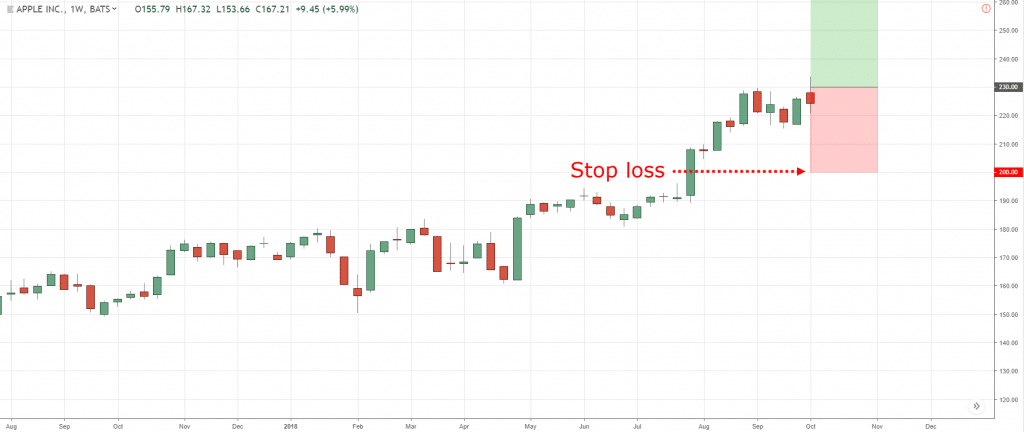
You buy Apple shares at $230 and accept a finish loss order at $200.
This means if the toll of Apple drops to $80, you will exit the trade and restrict your loss to $thirty per share (assuming no slippage).
Terminate loss on AAPL Weekly:
And if used correctly, a stop loss:
- Prevents you from blowing up a trading account
- Allows you to live and "fight" some other day
- Limits your losses to experience like an "emmet bite"
Now y'all might be thinking…
"Only my broker ever hunts my stop loss."
"A stop loss doesn't work for me."
"A stop loss reduces my profit."
But, that's not true.
Read on and you'll detect why…
(Or if you adopt, y'all can spotter this grooming beneath…)
The truth nearly stop loss nobody told you
Now:
Let'due south debunk some of the biggest myths about stop loss (that has fooled many traders).
Myth #1: My broker e'er hunt my stop loss
Almost regulated brokers don't hunt your finish loss because it'due south non worth the adventure.
Why?
Call back about this:
If the word gets out that ABC broker hunts their client stops loss, information technology'due south only a matter of time before existing clients pull out of their business relationship and join a new banker.
If you lot are a broker, would you lot want to risk doing that over a few measly pips?
I estimate not.
Most brokers don't hunt your stops as the gamble far outweighs the reward.
At present, you are probably thinking…
"But my broker widens the spread and stops me out of my trade."
There is a reason for this.
Allow me explicate…
A broker widens their spreads during major news release considering the futures market place (which they hedge their positions in) has low liquidity during this period.
If you look at the depth of market (aka the gild flow), you'll notice the bids and offers are thin but before major news release (like NFP) because the "players" in the marketplace are pulling out their orders ahead of the news release.
Thus, you become sparse liquidity during such period which results in a wider spread.
And because of this, the spreads in spot forex is widened (because if it isn't, there will be arbitraging opportunities).
So, information technology's not that your broker is widening their spread for fun, only they are doing it to protect themselves.
The bottom line is this…
Most brokers don't hunt your stop loss because it's bad for concern in the long run.
And they widen the spreads during major news release because the futures market is thin during this catamenia.
Myth #2: A stop loss reduces your profit
You might think having a cease loss is stupid.
Because the market always seems to hit your end loss, and then BOOM, it reverses dorsum to your intended direction.
And if you didn't accept a stop loss in identify, you'd be sitting in profits instead of having a loss, right?
But here'southward the thing…
All yous need is One fourth dimension when the marketplace doesn't reverse— and yous'll lose everything, and more.
Here's an example…
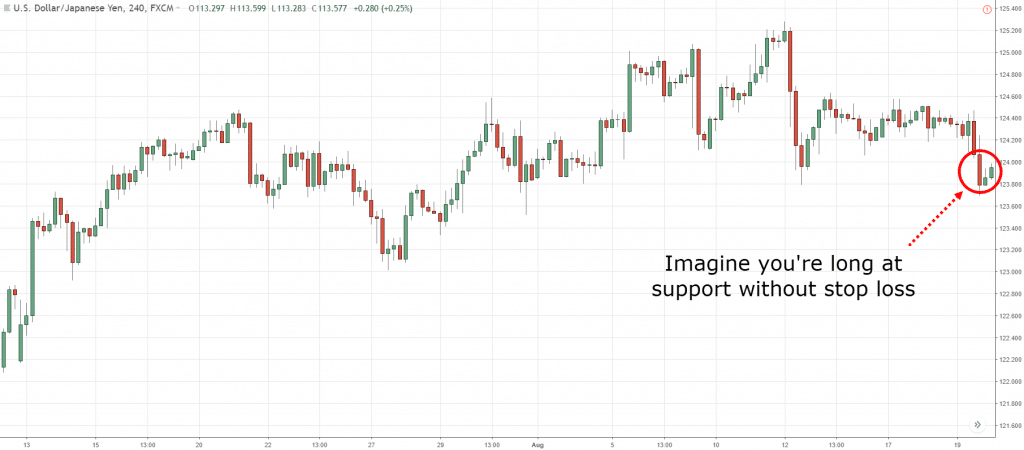
You buy at the expanse of Support with no end loss because the market volition "surely" opposite back in your favor:
And here'south what happens side by side…
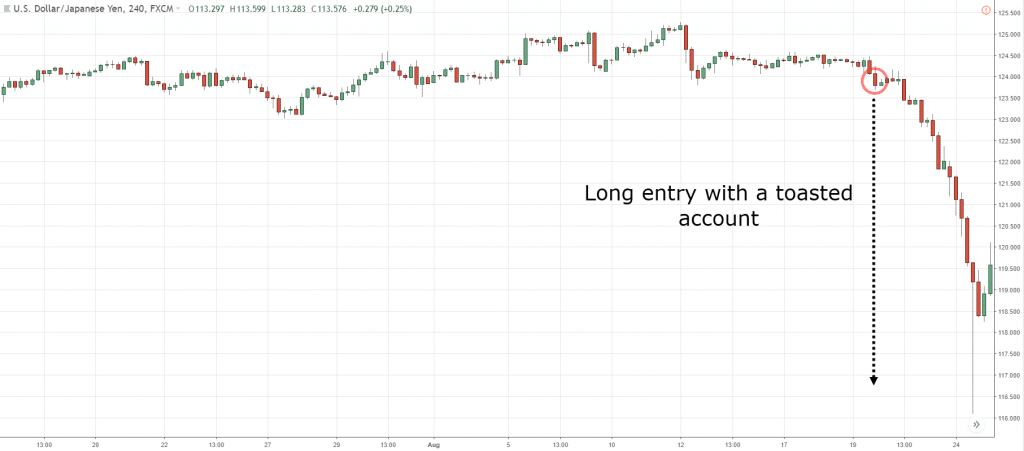
Do you see what I hateful?
I know information technology stinks when your stops go triggered unnecessarily.
But yous'd be glad you lot have it when sh*t hits the fan.
Myth #3: Yous should utilise a fixed end loss on every trade
At present, this is a big mistake.
Why?
Because not all markets are created equal.
Here's an case:
Right now, GBP/JPY has an average true range of 180 pips…
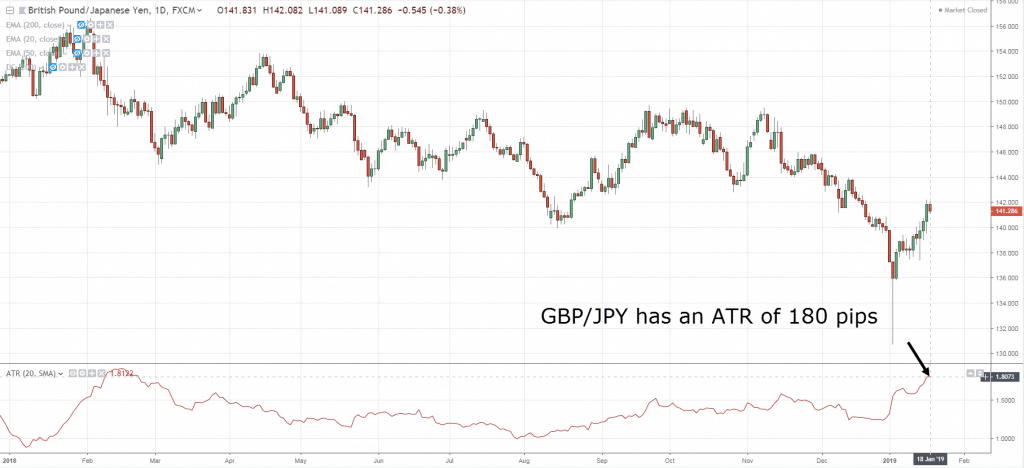
This means on average each day, it moves about 180 pips from the open to close.
Now, expect at the USD/CAD…
Information technology moves an average of 80 pips a day (open to close).
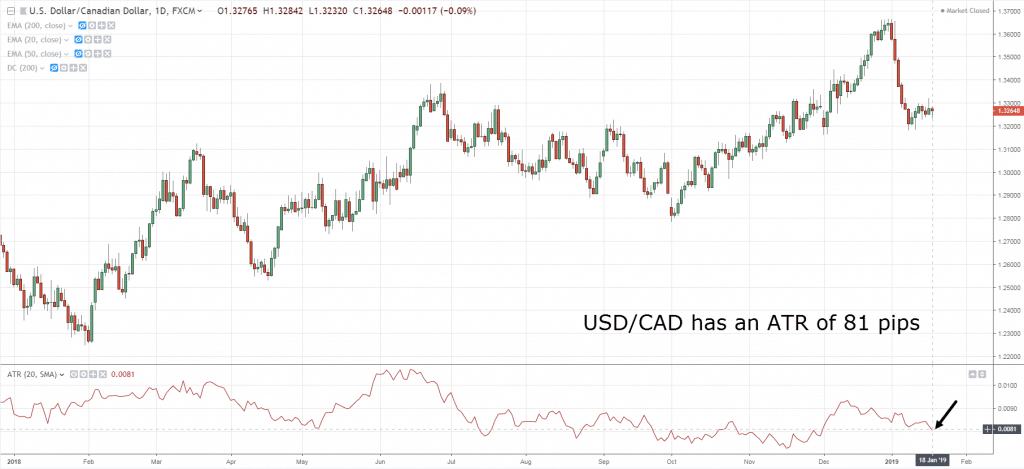
And then, what's the issue?
This means you lot shouldn't use a stock-still finish loss as they motility unlike "amount" each day.
A 100 pips stop loss on USD/CAD might be enough, merely on GBP/JPY, it's asking for problem (as it hands moves 180 pips a day).
Do you see my point?
Myth #4: Y'all should set your stop loss below Back up and above Resistance
This is a BAD idea.
Why?
Because you'll get terminate hunted, easily.
Don't believe me?
Then wait through your charts (or past trades)…
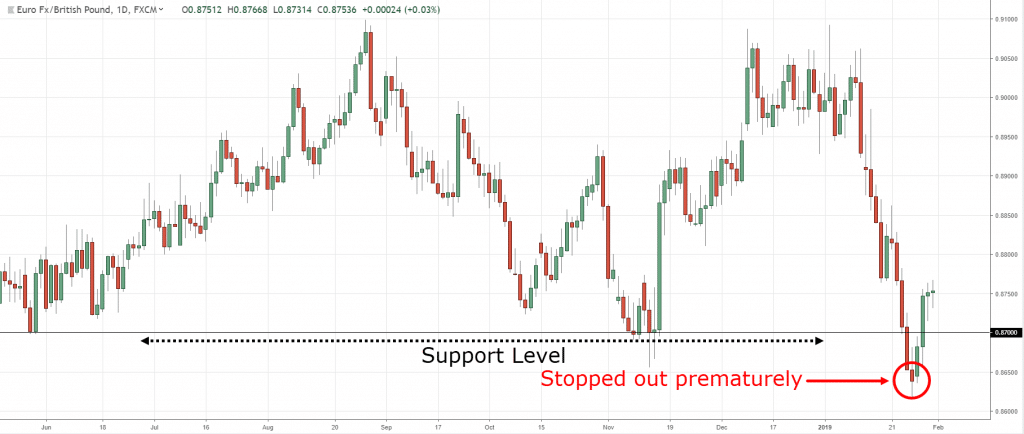
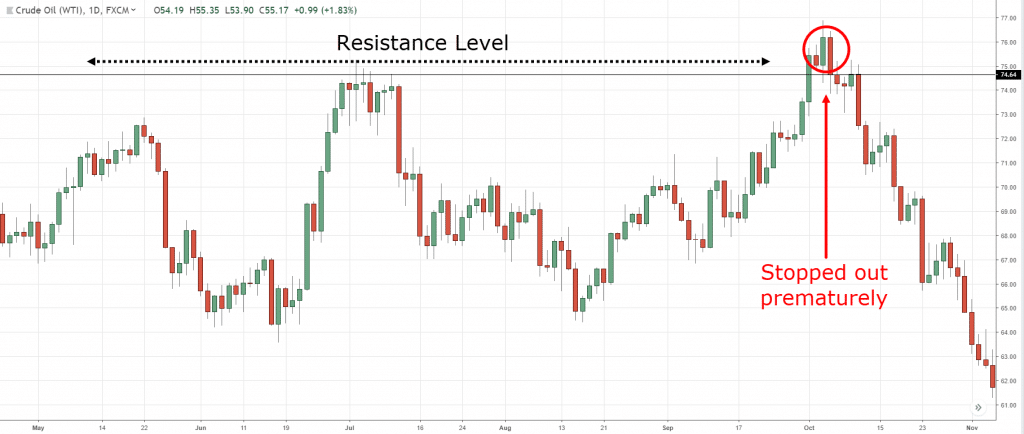
Observe how often the toll magically trades beneath Support and then reverse college?
And it'due south the same for Resistance.
The cost would merchandise merely above it, so, Boom, collapse lower.
Here's what I mean…
Support level at EUR/GBP Daily:
Resistance level at UKOIL Daily:
Why does it happen?
Considering that'southward how the "smart money" moves the market.
If yous want the full details, go watch this video beneath…
Now you're probably wondering…
"So how should I prepare my stop loss?"
That'due south what you'll discover adjacent.
Allow's go…
How to set stop loss like a professional trader
Here's my two-step technique that works…
- Identify the market structure
- Prepare your finish loss away from the market structure
The best part?
You tin can use this to any market or timeframe.
Here's how…
1. Identify the market construction
Marketplace structure refers to things like Support & Resistance, trendline, etc.
It acts equally a "barrier" to arrive hard for the price to become through.
For example:
You can remember of Back up like a "bulwark" that prevents the price from dropping lower.
If you want to learn how to place market construction, then get lookout this training below…
Anyway…
The key thing is to identify market place structure on your nautical chart considering y'all want the toll to accept difficulty reaching your stop loss.
ii. Gear up your stop loss away from the market structure
Call back:
You don't want to fix your stop loss at the market place construction (like merely below Support) because y'all'll get stop hunted easily.
Instead, give your stop loss some "buffer" away from the market structure.
Here's how…
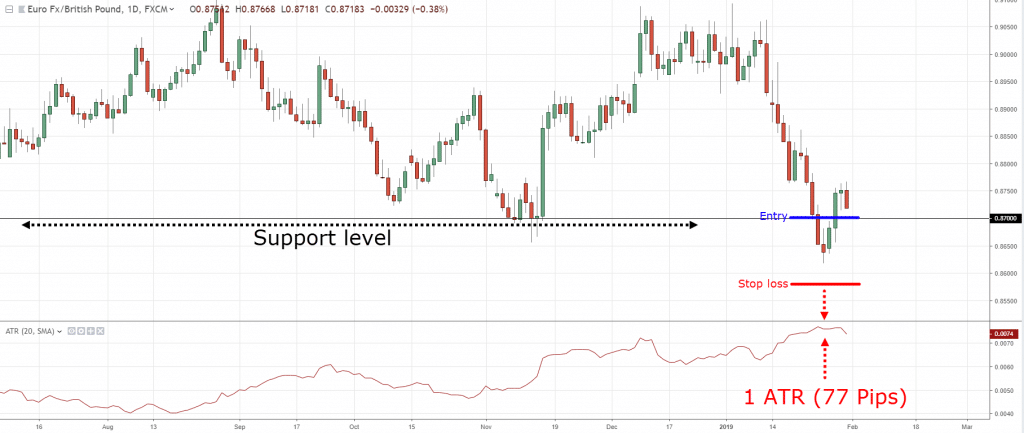
- Find out the electric current ATR value
- Add together the ATR value above market construction (for curt)
- Subtract the ATR value below market construction (for long)
Hither are a few examples…
Entry at Back up in EUR/GBP Daily:
Entry at Resistance in EUR/GBP Daily:
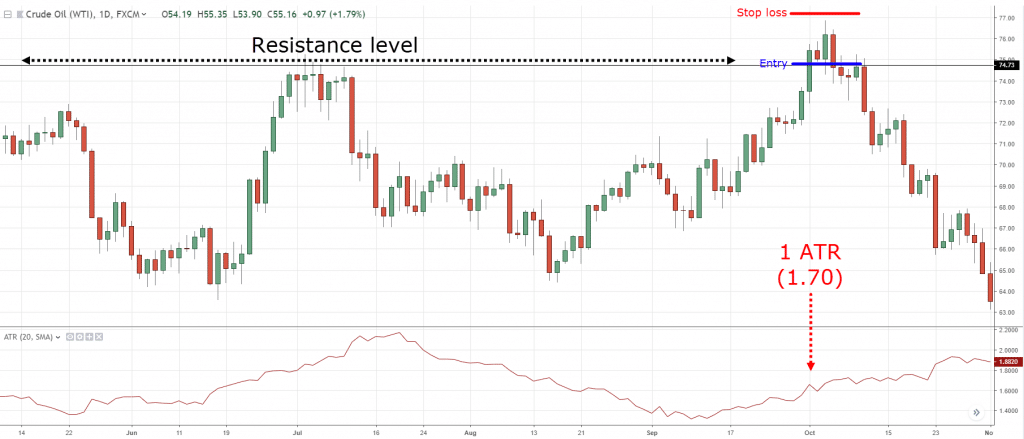
If you lot want more details, so go check out this training below…
How to employ ATR indicator to set cease loss
Terminate loss secrets: How to find astonishing trading opportunities most traders miss out
Earlier I dive deeper, you must sympathize the essence of risk management.
It consists of 3 things:
- The altitude of your end loss
- Risk per trade
- Position size
If you're a serious trader, you'll ever gamble a fraction of your capital (like 1% on each trade).
And so the question is:
How do you maintain the i% adventure on every trade?
Yous manipulate the other 2 variables, the distance of your cease loss and position size.
So…
If your stop loss is wide, your position size decreases (to keep your adventure constant).
If your terminate loss is tight, your position size increases (to go along your risk constant).
So the takeaway is this…
You want to have a tight stop loss so you can increase your position size and still proceed your risk constant.
This means…
The market needs to move lesser for you to earn 1R on your merchandise (compared to someone with a wider cease loss).
In other words…
You make more profits in a shorter amount of time.
Now y'all're probably wondering:
"What has this got to practice with finding amazing trading opportunities?"
The clandestine is this…
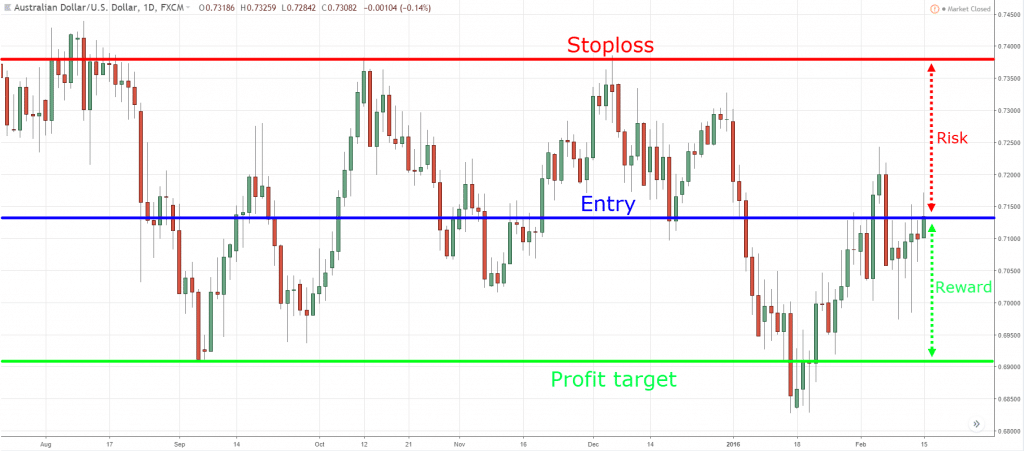
If y'all want to discover amazing trading opportunities, you must enter your trades close to the market structure.
Hither's what I mean…
Wide stop loss at AUD/USD Daily:
Tight stop loss at AUD/USD Daily:
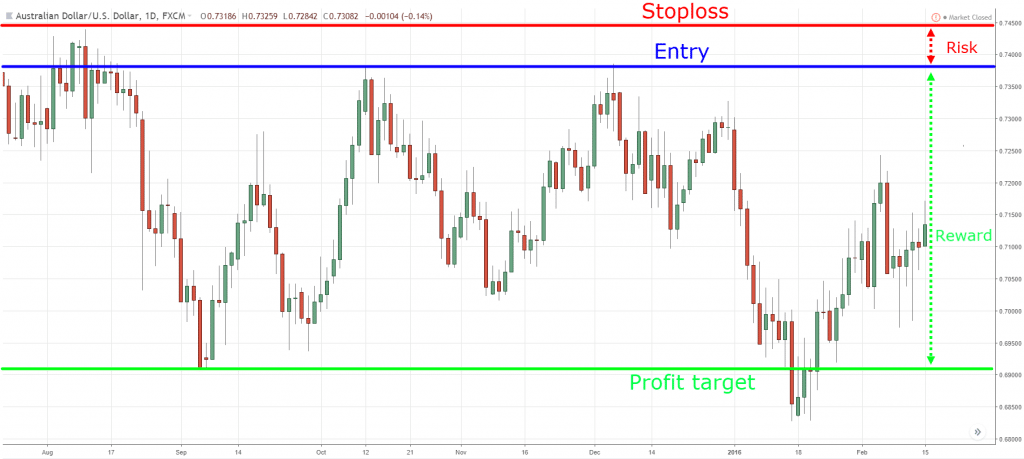
Tight stop loss (allow the marketplace come to your level with valid setup, show how much market needs to move to earn 1R)
As you tin can meet…
Both examples accept their finish loss at the aforementioned level.
The only thing is the distance of the stop loss — and that makes all the divergence.
Bonus Tip: How to adjust your stop loss and ride massive trends
Mostly:
Finish loss is used to protect your trading capital when the market moves against you.
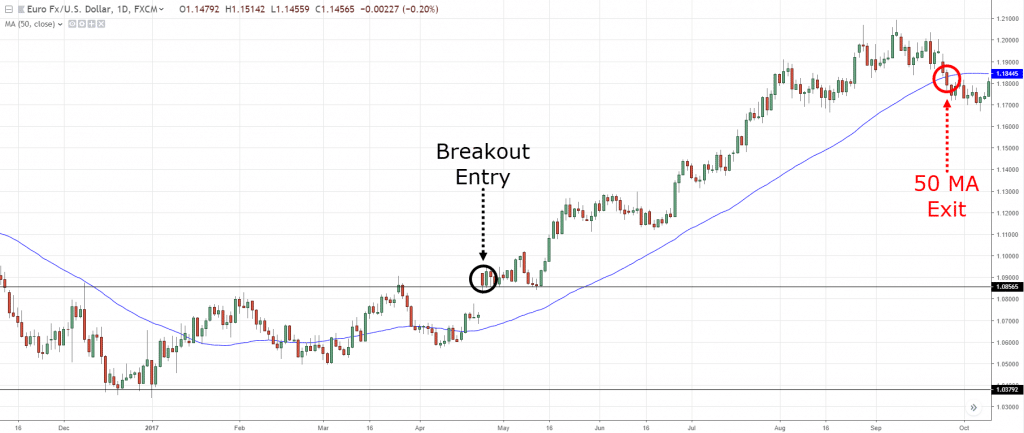
Merely it tin can also exist used to help yous ride massive trends — otherwise known as abaft cease loss.
This means as the marketplace moves in your favor, you accommodate your stop loss higher (in the hopes of riding a trend).
An instance:
In the chart below, you can see, EUR/USD broke out of Resistance (on Daily timeframe).
If you want to ride the tendency, you tin use a fifty-menses Moving Average (MA) to trail your end loss — and exit when the cost closes below it.
Now…
Moving Average is not the just manner to trail your stop loss.
If yous want to larn more, go read… 5 Powerful Techniques to Trail Your Stop Loss.
Frequently asked questions
#1: What if I identify a buy limit order to enter at the market construction with a tighter stop loss, but the price doesn't retest that structure and I miss the trading opportunity altogether?
If you miss that trading opportunity, then so be it because that's office and parcel of trading and you won't always catch every piece of the motility.
Alternatively, the price could create a new market structure that you can lean against to set your finish loss.
The last thing you want to be doing is to hunt the market place as y'all'll probable need a wider stop loss. That's when the marketplace is prone to a pullback or reversal, which would non be favourable for you lot.
#2: If I want to trade stocks and I cannot decrease my position size whatsoever farther, should I increase my % run a risk per trade just to have a end loss in place?
That's a choice yous take to make. Because if you're someone with a smaller account, information technology could be difficult to take chances 1% on each trade. Y'all might accept to deal with a 2% to iv% risk on each trade.
At the same time, when y'all're risking a larger percentage of your account, you lot should expect the drawdown to exist deeper as well.
Conclusion
So here's what yous've learned today:
- A cease loss protects your capital when the market moves against you
- Yous want to fix your end loss away from the market structure so yous don't get stopped out hands
- If you have a tighter stop loss, you tin increase your position size and withal keep your risk constant
- The best trading opportunities are nigh the market structure considering y'all can have a tighter stop loss
- A abaft finish loss allows you to ride massive trends and protects your open profits
Now over to you…
How do you use a end loss when trading?
Leave a comment below and share your thoughts with me.
Source: https://www.tradingwithrayner.com/stop-loss-order/
0 Response to "How To Set Proper Stop Loss"
Post a Comment